Free Inspection
Home › Tie-Downs & Anchoring
Installed to current Florida standards · Free anchor inspection with photos and a written report. Call (352) 888-2222.
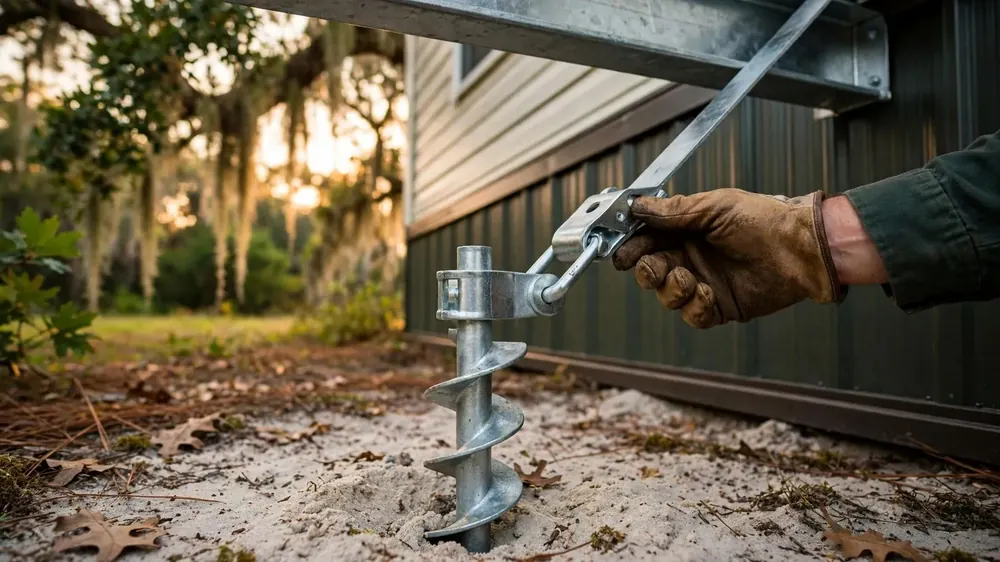
Ocala sits far enough inland that it dodges the worst of the coastline's storm surge — but Marion County still takes tropical-storm and hurricane-force wind, tornado spin-ups, and brutal summer thunderstorms every single year. A manufactured home is a well-built structure, but it's a comparatively light one sitting up on piers. What keeps it a home and not a hazard in high wind is its anchoring system: steel straps running from the frame down to ground anchors, tensioned so wind uplift and lateral force are transferred into the earth instead of into your walls.
Here's the uncomfortable truth about anchoring in Florida: it degrades invisibly. Straps corrode where they meet the soil. Anchor heads slowly work loose in sandy ground. Stabilizer plates rust. The system installed when the home was set — possibly decades ago, possibly to older standards — may look fine from the yard and be hanging on by very little underneath. Nobody discovers that in July. They discover it in September, on the news footage.
Most anchoring problems can't be confirmed from above ground, which is why the inspection is free — but these are the red flags: straps at the skirting line that are visibly rusted, kinked, or hanging loose; a home that has visibly shifted or rocked in a past storm; skirting that was cut open around anchors and never closed back up; a home set before the mid-1990s that has never had its anchoring reviewed since installation; or an insurance letter asking questions about tie-downs. Any of those is reason enough to get a pro under the home with a flashlight.
An anchor job starts with a full count and condition report: every existing anchor located, every strap checked for corrosion and tension, and the whole system compared against what your home's size and age require. Failed components are replaced — new anchors driven, new straps run and tensioned — and missing anchors are added at the required spacing. If the home has settled, re-leveling is usually done first or at the same visit, because tensioning straps on an unlevel home locks the problem in. When the work is complete you receive documentation of what was installed — the paperwork your insurance company actually wants to see.
Anchoring shows up in three financial moments of mobile home ownership. Insurance: Florida carriers scrutinize manufactured homes more every year, and verified, compliant tie-downs support your wind coverage and your premium. Selling: buyers' inspectors and lenders check anchoring, and documented upgrades remove a classic deal-killer. Storm season: June through November is a lot less stressful when you know exactly what's holding your home down, because a professional counted it, photographed it, and signed off on it.
Anchor inspections happen under the home — the same trip that checks your belly and vapor barrier, your piers for leveling, and your skirting from the back side. One free inspection covers all of it, with photos of everything.
Call (352) 888-2222 or send the form. You'll get a count, photos, and a written quote for only what your home actually needs.
Request My Free InspectionIt depends on the home's length, width, and its wind zone classification. Florida's installation standards (Rule 15C-1, based on the manufacturer's instructions and HUD requirements) specify anchor spacing — commonly every 5 feet 4 inches or closer along both frame rails, plus diagonal and vertical requirements that vary by home. During a free inspection, the pro counts your existing anchors, checks their condition, and tells you exactly what your home needs to be compliant.
Tie-down work is priced per anchor set after inspection, because homes vary so much — one might need six rusted straps replaced, another needs a complete new anchoring system. What you get before any work: a count of what's missing or failed, photos, and a written per-set price. Replacing failed components is far cheaper than a full system, and both are far cheaper than storm damage.
They can. Florida insurers increasingly verify anchoring on manufactured homes, and homes with missing, rusted, or non-compliant tie-downs can face higher premiums, limited wind coverage, or outright non-renewal. A documented anchor inspection and any needed upgrades give you paperwork that demonstrates your home meets current standards — bring it up with your agent after the work is done.
From above ground, you usually can't — anchors and straps live under the home. Warning signs anyone can spot: straps visible at the skirting line that are rusted through or hanging loose, and skirting that's been cut or left open around anchor points. The real answer comes from a free under-home inspection: straps are checked for corrosion and tension, anchor heads for pull-out, and stabilizer plates for condition.
One call gets a local specialist under your home with a flashlight, a level, and a written quote. Serving Ocala and all of Marion County.
(352) 888-2222